

Whey vs plant protein vs casein: which one should you use?
Whey vs plant protein vs casein, compared on amino acids, digestion speed and who each suits, plus a third option: complete protein that's pre-digested.

 By RecovPublished · Last updated · 5 min read
Whey is a fast-digesting dairy protein with the highest essential amino acid content of the common powders. Casein is the slow-digesting dairy protein. Plant proteins such as pea, rice and soy suit dairy-free and vegan diets but usually carry fewer essential amino acids. The third option is complete protein that arrives already digested.
What's the difference between whey and plant protein?
Whey is the protein fraction of milk that stays liquid when cheese is made. It's sold as concentrate, isolate or hydrolysate, and it's a complete protein. Plant protein powders are extracted from peas, brown rice, soy, hemp, oats and similar crops, often blended together.
The biggest measured difference is the amino acid profile. Researchers at Maastricht University analysed a large range of protein isolates and found essential amino acids made up 43% of whey protein, against 21–22% for oat, lupin and wheat protein (Gorissen et al., Amino Acids, 2018). Plant proteins were also typically lower in methionine and lysine. Leucine content varied widely between plant sources.
| Whey | Plant blends (pea, rice, soy) | Recov | |
|---|---|---|---|
| Source | Milk | Legumes and grains | Porcine plasma protein |
| Complete protein? | Yes | Depends on the blend | Yes: all 20 amino acids |
| Digestion | Fast | Varies | Already broken down into di- and tri-peptides |
| Contains dairy? | Yes (isolate is low-lactose) | No | No |
| Vegan? | No | Yes | No |
| Format | Powder shaken with liquid | Powder shaken with liquid | Tablets swallowed with water |
| Sweeteners | Often (check the label) | Often (check the label) | None |
Is whey or plant protein better for people who train?
On amino acids alone, whey has the edge. A review in the Journal of Nutrition found soy and wheat protein produced a lower muscle protein synthetic response than several animal proteins, and linked this to lower digestibility, a relative lack of some essential amino acids and lower leucine in most plant proteins (van Vliet et al., 2015).
Plant protein closes much of that gap when it's blended. The same Maastricht analysis found that combining plant isolates, or blending plant with animal proteins, can produce a profile close to animal protein (Gorissen et al., 2018).
For context, the joint position statement from the Academy of Nutrition and Dietetics, Dietitians of Canada and the American College of Sports Medicine puts athletes at 1.2–2.0 g of protein per kilogram of body weight a day (Thomas et al., 2016).
Is there a downside to plant-based protein?
Two, mainly. The first is the amino acid gap covered above, which you manage by choosing a blend and eating enough of it. The second is what comes with the protein. Monash University's FODMAP team notes that plant proteins such as soy and pea can be hard to purify and often carry some fermentable carbohydrates. Many plant powders also add gums, fibres and sweeteners for texture and taste, so read the ingredient list, not just the protein figure. If powders sit badly with you, protein for a sensitive stomach walks through the usual culprits.
Pre-digested plasma peptides. All 20 amino acids, absorbed in 15–25 min.
Recov Protein Concentrate
Shop Recov →From $2.67/day · free AU shipping over $99 · pause or cancel anytimeWhat's the difference between whey and casein?
Both come from milk, and both are complete proteins. The difference is speed. In a landmark 1997 study, whey produced a fast, sharp but short rise in blood amino acids, while casein produced a slower, longer plateau, probably because it empties from the stomach more slowly (Boirie et al., PNAS, 1997).
The International Society of Sports Nutrition's position stand notes that 30–40 g of casein taken before bed increases overnight muscle protein synthesis (Jäger et al., 2017).
What's the third option?
Whole whey, casein and plant proteins have to be digested before your body can use them. Whey hydrolysate is pre-hydrolysed, but like the others it's a powder you mix. Recov is built the other way round.
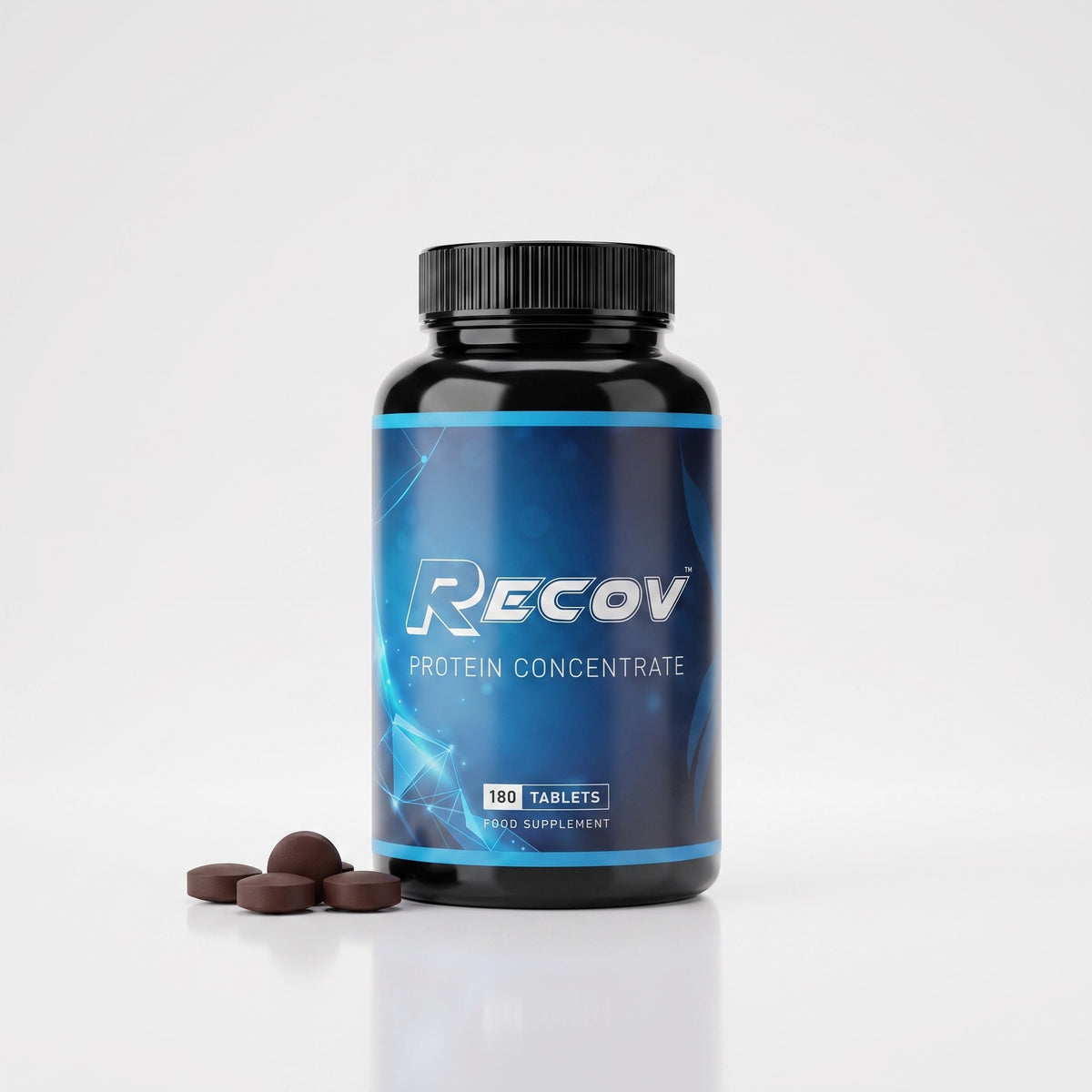
It's a complete protein with all 20 amino acids, made from one source, porcine plasma protein, and it's pre-digested into di- and tri-peptides before it's pressed into tablets. Your gut takes those up through PEPT1, a transporter built for peptides of exactly that size, and they reach the bloodstream in 15–25 minutes (our stated absorption time). Your whole bloodstream carries only 2–3g of amino acids at any moment. Six tablets of Recov deliver roughly that entire amount, already broken down into small peptides your body absorbs directly.
It's also dairy-free and whey-free, with no sweeteners, flavours or colours, and nothing to mix.
Which protein should you choose?
Choose by the job you need done:
- Whey if dairy suits you and you want a fast-digesting protein.
- Casein if dairy suits you and you want a slower-digesting protein.
- A plant blend if you're vegan. Blends of plant proteins come closer to animal protein's amino acid profile (Gorissen et al., 2018).
- Recov if you want complete protein with no dairy and no mixing, already broken down, in a bottle that goes anywhere.
If you avoid dairy but don't want a plant powder, dairy-free protein that isn't plant-based lays out every option. For BCAAs, EAAs and complete protein, see our guide to amino acid supplements. If you've been eyeing collagen, collagen protein powder vs whey explains what collagen is actually for.
Recov is an Australian brand, sold since 2010 and made to EU manufacturing standards. Six tablets a day is the standard, 8–12 suits heavier training days and 12–18 the biggest blocks. You can see the product here.
Frequently asked questions
Is whey or plant protein healthier?
Neither is "healthier" by default. Whey has a higher essential amino acid content. Plant blends suit vegan and dairy-free diets. Check the label for added sweeteners and fillers either way.
Is whey protein a complete protein?
Yes. Whey contains every essential amino acid. So does casein.
Are plant proteins lower in some amino acids?
Yes. In the Maastricht analysis, plant proteins were typically lower in methionine and lysine than animal proteins, and blending plant isolates, or plant with animal proteins, brought the profile closer to animal protein (Gorissen et al., 2018).
Is casein better than whey?
They do different jobs. Whey digests fast and casein digests slowly (Boirie et al., 1997).
Is Recov a whey protein?
No. Recov is made from porcine plasma protein. It's dairy-free and whey-free, and it isn't suitable for vegetarians, vegans or anyone who avoids porcine-derived ingredients.
Is Recov a protein powder?
No. Recov is tablets you swallow with water: complete protein with all 20 amino acids, pre-digested into di- and tri-peptides, with nothing to mix.
Anti-doping bodies do not approve or endorse any supplement; if you are drug-tested, check Recov with your sporting body before you take it. Questions: management@recovfaster.com.
Sources
- Gorissen SHM et al. (2018), "Protein content and amino acid composition of commercially available plant-based protein isolates", Amino Acids (PMID 30167963)
- van Vliet S, Burd NA, van Loon LJ (2015), "The Skeletal Muscle Anabolic Response to Plant- versus Animal-Based Protein Consumption", Journal of Nutrition (PMID 26224750)
- Boirie Y et al. (1997), "Slow and fast dietary proteins differently modulate postprandial protein accretion", PNAS (PMID 9405716)
- Jäger R et al. (2017), "International Society of Sports Nutrition Position Stand: protein and exercise" (PMID 28642676)
- Thomas DT, Erdman KA, Burke LM (2016), "Nutrition and Athletic Performance", joint position statement (PMID 26920240)
- Monash University FODMAP, "Protein Powders and IBS: Low FODMAP Guide" (plant protein purification, lactose in whey concentrate vs isolate)
- Recov product page (dose, dairy-free and whey-free badges, EU manufacturing, 2010)