
Protein science report
Amino acid supplements: EAAs, BCAAs or complete protein?
What amino acid supplements actually give you: BCAAs, EAAs and complete protein compared, EAA vs BCAA explained, and how to read an amino acid label.
Amino acid supplements come in three forms. BCAA products supply three amino acids: leucine, isoleucine and valine. EAA products supply the essential amino acids, the ones your body can't make. A complete protein supplies all 20 amino acids your body builds with. If you want the full set in one product, choose complete protein.
What are amino acid supplements?
Amino acids are the building blocks of protein. Your body strings 20 of them together to make everything from muscle to enzymes to the transport proteins in your blood. According to the Victorian Government's Better Health Channel, your body can make 11 of them itself. The other 9 it can't make, so they have to come from what you eat. Those are the essential amino acids: histidine, isoleucine, leucine, lysine, methionine, phenylalanine, threonine, tryptophan and valine.
An amino acid supplement is any product that supplies some or all of those 20. They sit in three groups:
- BCAAs (branched-chain amino acids): leucine, isoleucine and valine, and nothing else.
- EAAs (essential amino acids): the essential amino acids, usually as a free-form powder or tablet.
- Complete protein: all 20 amino acids, essential and non-essential, either as whole protein or pre-digested into short chains.
What is the difference between EAA and BCAA?
A BCAA product is a subset of an EAA product. Every EAA formula already contains the three BCAAs. A complete protein contains both groups, plus the non-essential amino acids.
| BCAA product | EAA product | Complete protein (Recov) | |
|---|---|---|---|
| Amino acids supplied | 3 | The essential amino acids | All 20 |
| Leucine, isoleucine, valine | Yes | Yes | Yes |
| Lysine, methionine, tryptophan and the other essentials | No | Yes | Yes |
| Non-essential amino acids (glycine, arginine, glutamic acid and others) | No | No | Yes |
| Usual form | Free-form powder or capsules | Free-form powder or tablets | Di- and tri-peptides, pressed into tablets |
| Every amino acid listed on the label | Usually | Varies (some use one blend total) | Yes, in milligrams (18 label rows cover all 20) |
"Your whole bloodstream carries only 2–3g of amino acids at any moment. Six tablets of Recov deliver roughly that entire amount, already broken down into small peptides your body absorbs directly."
Recov's formulation teamDo I need BCAAs if I take EAAs?
No. The three BCAAs are already inside any EAA product and any complete protein, so a separate BCAA product doubles up on three amino acids you're already getting.
The research on BCAAs taken alone is mixed. A 2017 trial found a BCAA drink after resistance training raised muscle protein synthesis 22% above a placebo drink (Jackman et al., Frontiers in Physiology). A review the same year by Robert Wolfe made the counterpoint: building new protein needs every essential amino acid, and when only three arrive, the rest have to be drawn from the body's own protein (Wolfe, Journal of the International Society of Sports Nutrition, 2017). The Jackman paper itself opens by noting that intact protein or the essential amino acids are what stimulate muscle protein synthesis after resistance exercise.
Pre-digested plasma peptides. All 20 amino acids, absorbed in 15–25 min.
Recov Protein Concentrate
Shop Recov →From $2.67/day · free AU shipping over $99 · pause or cancel anytimeWhat does the research say about complete protein and EAAs?
It points to the full set of essential amino acids, from whole food first. The International Society of Sports Nutrition's position stand on protein puts it plainly: "Athletes should consider focusing on whole food sources of protein that contain all of the EAAs (i.e., it is the EAAs that are required to stimulate MPS)" (Jäger et al., 2017). In other words, the full set matters more than any single amino acid, and whole-food protein is the foundation.
A complete protein supplies more than the essentials: it also carries the non-essential amino acids, the way protein arrives in food.
What forms do amino acid supplements come in?
Amino acid products differ in form as well as content. Free-form amino acids are single molecules. Whole protein arrives as long chains your gut breaks down. Pre-digested protein arrives already broken down into di- and tri-peptides, chains of two or three amino acids, which your gut wall takes up through a transporter called PEPT1. Pre-digested protein covers the process in more detail.
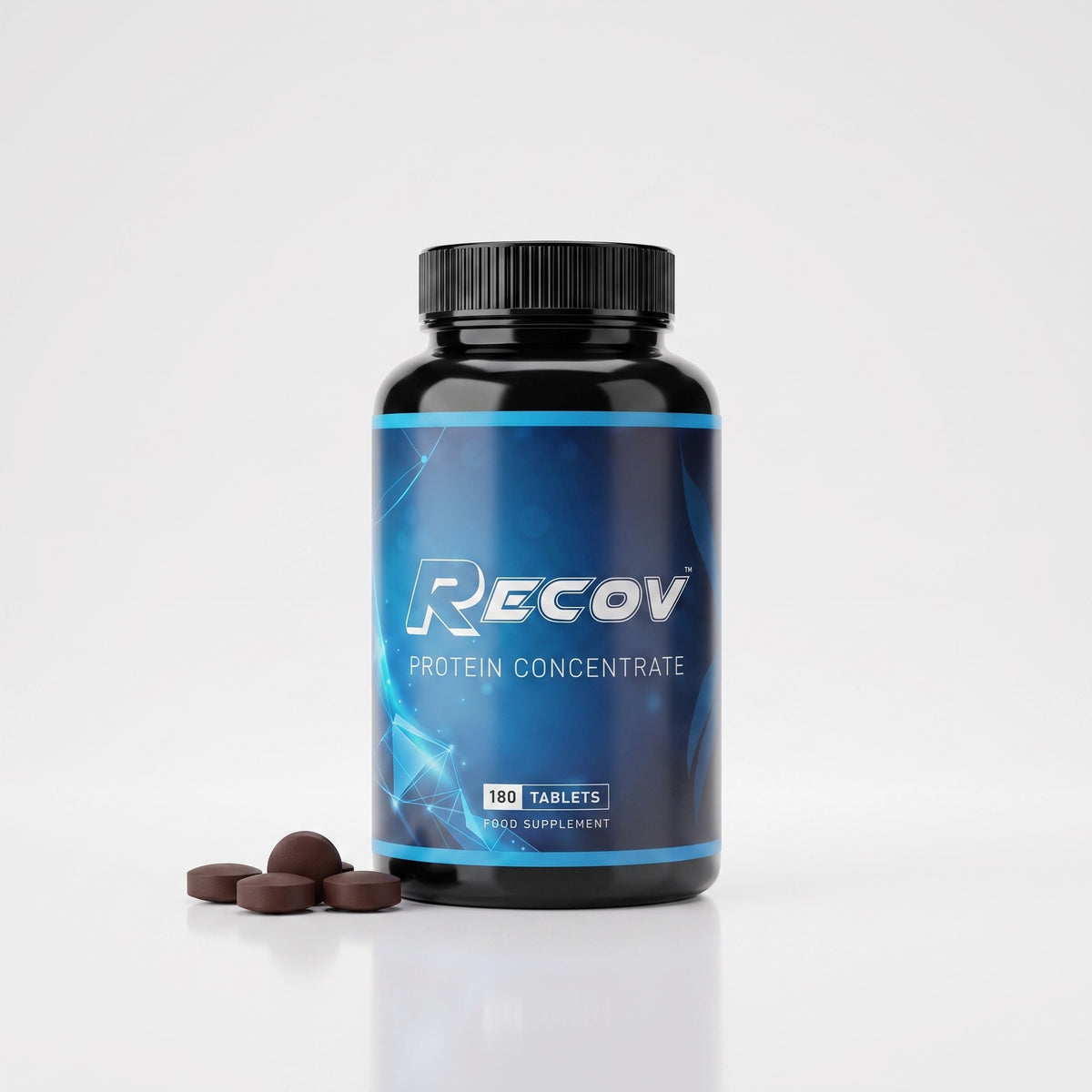
Recov is the pre-digested kind. It's a complete protein with all 20 amino acids, pre-digested into di- and tri-peptides from one source, porcine plasma protein, and it reaches the bloodstream in 15–25 minutes (our stated absorption time). Your whole bloodstream carries only 2–3g of amino acids at any moment. Six tablets of Recov deliver roughly that entire amount, already broken down into small peptides your body absorbs directly. You can see the product here.
What does an amino acid supplement add to a normal diet?
Convenience and timing. Food comes first: meat, fish, eggs, dairy, legumes and grains all supply protein, and a varied diet covers the essentials for most people. A supplement earns its place when you want amino acids at a time food doesn't suit, like just before training, or in a form that travels.
For reference, Australia's Nutrient Reference Values set the recommended dietary intake for adults aged 19–70 at 0.84 g of protein per kilogram of body weight a day for men and 0.75 g/kg for women. The 2016 joint position statement from the Academy of Nutrition and Dietetics, Dietitians of Canada and the American College of Sports Medicine puts athletes at 1.2–2.0 g/kg (Thomas et al., 2016). Those daily targets are built from meals.
Is it safe to take amino acids every day?
Amino acids are the normal content of every protein you eat, and protein supplements are designed for daily use. Take them as the label directs. Speak to your doctor first if you're pregnant or breastfeeding, managing a medical condition or taking medication.
One group needs to avoid them: people with phenylketonuria (PKU). Healthdirect explains that people with PKU can't break down a certain amino acid, phenylalanine, and need to follow a diet low in it. Phenylalanine is in every complete protein and in most EAA formulas, Recov included.
Recov is also unsuitable for vegetarians, vegans and anyone who avoids porcine-derived ingredients.
How do you choose an amino acid supplement?
- Decide how many amino acids you want. Three (BCAA), the essentials (EAA), or all 20 (complete protein).
- Read the label. Check whether each amino acid is listed with its own amount, or whether the label gives one total for a blend. Recov lists every amino acid in milligrams on its ingredients page.
- Check the form. Free-form amino acids, whole protein and pre-digested di- and tri-peptides are absorbed differently.
- Check what else is in it. Many amino products carry sweeteners, flavours and colours. Recov has none.
- Check with your sporting body if you compete. Anti-doping bodies don't approve supplements, so be wary of any label that says they do, and check any product with your sporting body before you take it.
- Check it suits your diet. Some products are vegan and some aren't.
If you're comparing tablet brands, our side-by-side of Perfect Amino vs Recov puts an EAA tablet and a complete-protein tablet next to each other.
Frequently asked questions
Are EAAs better than BCAAs?
EAAs are the more complete choice. They contain the three BCAAs plus the other essential amino acids, which new protein can't be built without.
Is Recov an EAA supplement?
No. Recov is a complete protein with all 20 amino acids, essential and non-essential, from one source: porcine plasma protein, pre-digested into di- and tri-peptides. Every amino acid is listed in milligrams on the ingredients page.
When is the best time to take an amino acid supplement?
Around training suits most people. With Recov, take four tablets about 30 minutes before training and two straight after, with four more before bed on heavier days. Six a day is the standard, 8–12 suits heavier training days, and 12–18 the biggest blocks.
Can I take amino acids with protein powder?
Yes. There's no conflict between them. If you're done with the shaker, see protein tablets vs protein powder.
Who should not take amino acid supplements?
People with phenylketonuria (PKU). Anyone who is pregnant, breastfeeding, managing a medical condition or on medication should check with their doctor first. Recov is also unsuitable for vegetarians, vegans and anyone who avoids porcine-derived ingredients.
Is Recov suitable for vegans?
No. Recov is made from porcine plasma protein, so it isn't suitable for vegetarians, vegans or anyone who avoids porcine-derived ingredients. If you want a vegan tablet, see how an EAA tablet compares in Perfect Amino vs Recov.
Recov is an Australian brand. Anti-doping bodies do not approve or endorse any supplement; if you are drug-tested, check Recov with your sporting body before you take it. Always read the label and follow the directions for use. Questions: management@recovfaster.com.
Sources
- Better Health Channel (Victorian Government), "Protein" (11 non-essential and 9 essential amino acids)
- Jackman SR et al. (2017), "Branched-Chain Amino Acid Ingestion Stimulates Muscle Myofibrillar Protein Synthesis following Resistance Exercise in Humans", Frontiers in Physiology (PMID 28638350)
- Wolfe RR (2017), "Branched-chain amino acids and muscle protein synthesis in humans: myth or reality?", Journal of the International Society of Sports Nutrition (PMID 28852372)
- Jäger R et al. (2017), "International Society of Sports Nutrition Position Stand: protein and exercise" (PMID 28642676)
- NHMRC Nutrient Reference Values, Protein (Eat For Health)
- Thomas DT, Erdman KA, Burke LM (2016), "Nutrition and Athletic Performance", joint position statement (PMID 26920240)
- Healthdirect, "Phenylketonuria"
- Recov ingredients page (label panel in milligrams, ingredients)