
Protein supplements for muscle gain: what actually works?
Which protein supplements help you build muscle, how much protein you need, and when to take it. What 49 trials found, and where Recov fits.

The quick answer
Protein supplements help you gain muscle when you lift weights and they lift your daily protein toward about 1.6 g per kilogram of body weight. A review of 49 trials found gains in strength and lean mass, with lean-mass gains levelling off at that intake. The best supplement is a complete protein you'll take every day.
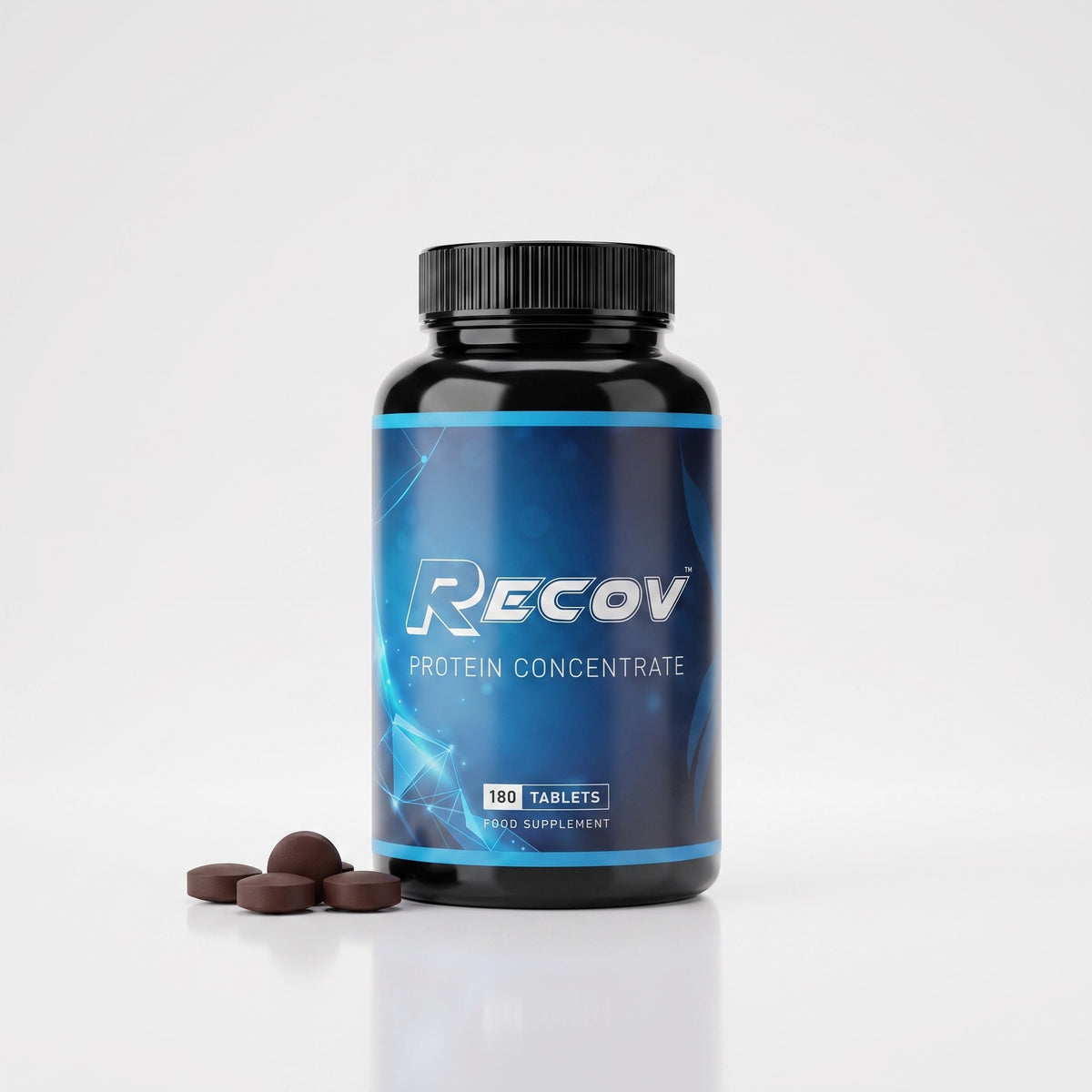
About us: we're Recov, an Australian brand from Future Supplements Pty Limited. Recov Protein Concentrate is a complete protein, pre-digested and pressed into tablets, and it has been sold since 2010: 180 tablets a bottle, from $79.95 on subscription.
Do protein supplements help you gain muscle?
Yes, alongside resistance training. The training is the stimulus. Protein supplies the material.
The strongest evidence is a 2018 meta-analysis in the British Journal of Sports Medicine by Morton and colleagues. It pooled 49 randomised controlled trials with 1,863 participants who did resistance training for at least six weeks. Adding a protein supplement increased gains in one-rep-max strength by an average of 2.49 kg and lean mass by 0.30 kg, and it increased muscle fibre size.
Two details matter. The benefit was larger in people who were already resistance-trained. And lean-mass gains stopped growing once total protein intake passed about 1.62 g per kilogram of body weight a day.
How much protein do you need to build muscle?
More than the general guideline, spread through the day.
- General adult baseline: for adults aged 19–70, the NHMRC recommends 0.84 g per kilogram of body weight a day for men and 0.75 g/kg for women.
- Building muscle: the International Society of Sports Nutrition (ISSN) puts most people who exercise at 1.4–2.0 g/kg a day. The 2016 joint position statement from the American College of Sports Medicine, Academy of Nutrition and Dietetics and Dietitians of Canada puts athletes at 1.2–2.0 g/kg.
- Per serve: the ISSN suggests about 0.25 g/kg of high-quality protein, or 20–40 g, every three to four hours.
For an 80 kg lifter, 1.6 g/kg is about 128 g of protein a day. Most of that should come from meals. A supplement closes the gap.
Which protein supplement is best for muscle gain?
The one that's a complete protein and fits your day. Here's how the common types compare.
| Supplement | What it is | Complete protein? | How you take it | Where it fits |
|---|---|---|---|---|
| Whey | Milk protein left over from cheese-making | Yes | Powder shaken with water or milk | Around training, if dairy suits you |
| Casein | The main protein in milk, slower to digest | Yes | Powder or dairy foods | Evenings and long gaps between meals |
| Plant blends | Pea, rice, soy or hemp, often mixed | Depends on the blend | Powder | Vegan diets |
| Mass gainers | Protein plus a large dose of carbohydrate | Usually | Large shake | When you need a lot of extra kilojoules |
| BCAAs | Three amino acids: leucine, isoleucine and valine | No | Powder or capsules | Not a protein source on their own |
| Recov | Porcine plasma protein, pre-digested into di- and tri-peptides | Yes: all 20 amino acids | Tablets with water | Around training, between meals, on the road |
Two points from the research sit behind that table. The ISSN notes that it's the essential amino acids that drive muscle protein synthesis, which is why three BCAAs alone don't do the job. And a 2018 analysis of commercial plant protein isolates in Amino Acids (Gorissen et al.) found many plant isolates had lower essential amino acid content than animal proteins, which is why plant powders are usually blended.
Pre-digested plasma peptides. All 20 amino acids, absorbed in 15–25 min.
Recov Protein Concentrate
Shop Recov →From $2.67/day · free AU shipping over $99 · pause or cancel anytimeIs there a pill you can take for protein?
Yes, but check what's in it. "Protein pills" range from single amino acids and BCAA capsules to collagen caps, which aren't a complete protein (collagen lacks tryptophan), to complete protein in tablet form. Our guide to protein capsules and pills breaks down each type.
Recov is the complete kind. Every tablet is pre-digested plasma protein carrying all 20 amino acids, so there's no powder to measure and no shaker to rinse.
When should you take protein for muscle gain?
Around your training, and evenly through the day. The ISSN finds protein works with resistance exercise whether you take it before or after the session, and notes that the effect of a workout lasts at least 24 hours. It recommends spreading protein doses every three to four hours.
A 2014 study in the Journal of Nutrition (Mamerow et al.) found 24-hour muscle protein synthesis was 25% higher when the same daily protein was spread evenly across three meals than when most of it came at dinner. Evenings count too: our guide to protein before bed covers the overnight research. And there's no hard cap on how much you can absorb in one sitting, as our guide to how much protein you can absorb at once explains.
Where does Recov fit in a muscle-building plan?
Right around the session, where a heavy shake is least welcome. Recov is porcine plasma protein pre-digested into di- and tri-peptides. Your gut takes them up through PEPT1, a transporter built for peptides that size, and they reach your bloodstream in 15–25 minutes. We call this the Bi-Peptide Window.
Your whole bloodstream carries only 2–3g of amino acids at any moment. Six tablets of Recov deliver roughly that entire amount, already broken down into small peptides your body absorbs directly.
The dosing chart on the product page sets out each level. On the Training level, that's two tablets on waking, four before your session and two after, with four more before bed on heavier days: 8–12 a day. The heaviest blocks sit at 12–18. It's dairy-free, with no sweeteners or flavours, and a 180-tablet bottle fits in a gym bag.
Who shouldn't use Recov?
Recov is made from porcine plasma protein, so it isn't suitable for vegetarians, vegans, or anyone following a halal or kosher diet. If you're pregnant, breastfeeding, managing a health condition or taking prescription medication, talk to your health professional before starting any supplement.
Frequently asked questions
Which protein supplement is best for muscle gain?
A complete protein you'll take consistently, alongside resistance training. Whey, casein and Recov are all complete. BCAAs are not.
Can you build muscle without protein powder?
Yes. Powder is only one format. Food, protein tablets like Recov, or both can take you to your daily target.
Is creatine a protein supplement?
No. Creatine is a separate supplement, not a source of protein or amino acids for building muscle tissue.
How much protein should I eat per meal to build muscle?
Around 0.4 g per kilogram of body weight per meal, across at least four meals, according to Schoenfeld and Aragon's 2018 review. That's about 32 g a meal for an 80 kg person.
Are BCAAs enough to build muscle?
No. BCAAs are three amino acids. Muscle protein synthesis needs all the essential amino acids, which a complete protein supplies.
How do I take Recov for training?
With water: two tablets on waking, four before your session and two after, plus four before bed on heavier days, for 8–12 a day. A 180-tablet bottle is $119.95 one-time or from $79.95 on subscription, with a money-back guarantee on your first order. See Recov Protein Concentrate.
Recov is made to EU manufacturing standards. Always read the label and follow the directions for use.
Sources
- Morton RW et al. (2018), "A systematic review, meta-analysis and meta-regression of the effect of protein supplementation on resistance training-induced gains in muscle mass and strength in healthy adults", British Journal of Sports Medicine 52(6):376–384 (PMID 28698222)
- Jäger R et al. (2017), "International Society of Sports Nutrition Position Stand: protein and exercise", Journal of the International Society of Sports Nutrition 14:20 (PMID 28642676)
- Thomas DT, Erdman KA, Burke LM (2016), "Nutrition and Athletic Performance", joint position statement (PMID 26920240)
- NHMRC Nutrient Reference Values, Protein
- Mamerow MM et al. (2014), "Dietary protein distribution positively influences 24-h muscle protein synthesis in healthy adults", Journal of Nutrition 144(6):876–880 (PMID 24477298)
- Schoenfeld BJ, Aragon AA (2018), "How much protein can the body use in a single meal for muscle-building?", Journal of the International Society of Sports Nutrition 15:10 (PMID 29497353)
- Gorissen SHM et al. (2018), "Protein content and amino acid composition of commercially available plant-based protein isolates", Amino Acids 50(12):1685–1695 (PMID 30167963)
- Recov science page (PEPT1)
- Recov product page (15–25 minutes, dosing, price, guarantee)