

Protein science report
How much protein can you absorb at once?
There's no hard cap on protein absorption per meal. What 18 trials show about how much reaches your bloodstream, how fast, and how to spread it.
There's no hard limit on how much protein your gut can absorb at once. What changes is speed: across 18 trials and 602 people, about half the amino acids from a serve of milk-based protein reached the bloodstream within five hours. The practical answer is to spread your protein across three or four meals a day.
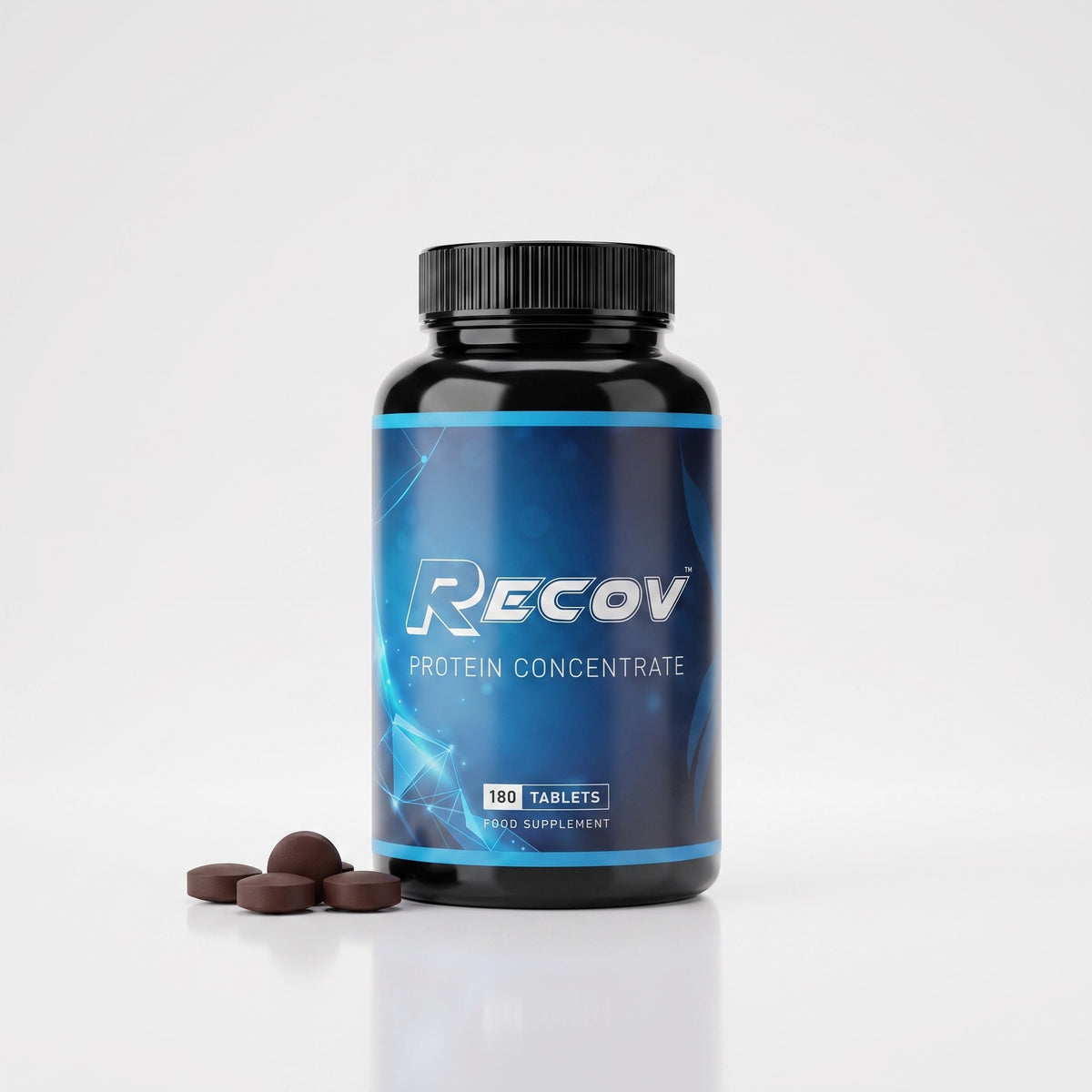
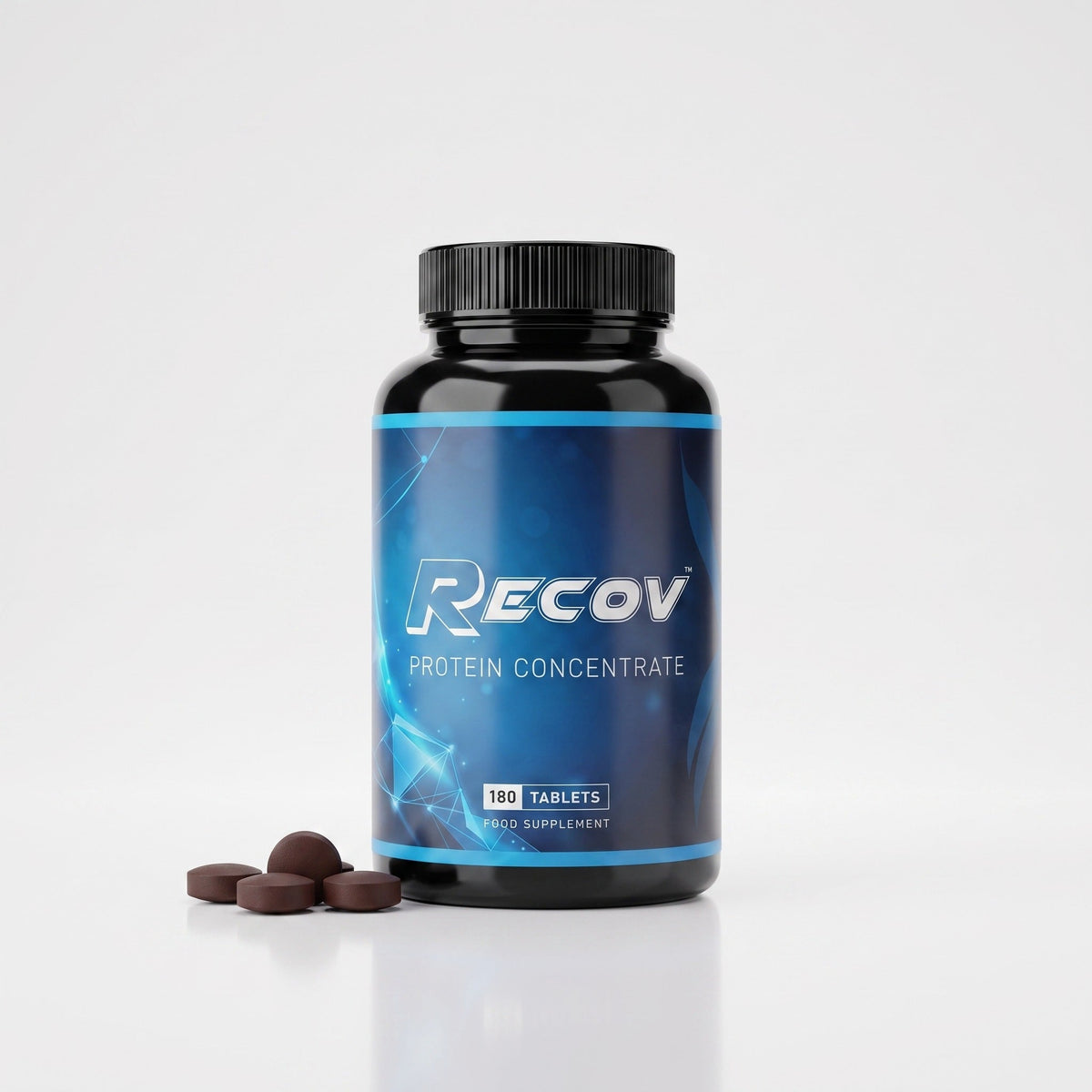
About us: we're Recov, an Australian brand from Future Supplements Pty Limited. Since 2010 we've made Recov Protein Concentrate, a complete protein pre-digested into tablets: 180 tablets a bottle, $119.95 one-time or from $79.95 on subscription.
Is there a limit to how much protein you can absorb at once?
Not a hard one. Absorbing protein and using it are two different questions, and the old 20–30 g rule mixes them up.
Your small intestine keeps taking up amino acids from a large serve. It simply takes longer. In a 2023 study in Cell Reports Medicine, Trommelen and colleagues randomised 36 healthy young men to a placebo, 25 g or 100 g of protein after exercise. The 100 g serve produced a larger response that lasted more than 12 hours, and most of the extra protein was used rather than burned.
The 20–30 g idea came from short studies of fast-digesting protein taken on its own. Schoenfeld and Aragon's 2018 review in the Journal of the International Society of Sports Nutrition points out that slower proteins, eaten with other food, arrive over a longer window and are still used.
How much of the protein you eat reaches your bloodstream?
This is the number no tub label prints. Gorissen and colleagues pooled 18 randomised controlled trials with 602 participants (Journal of Nutrition, 2020). On average, 50% of the amino acids from the protein appeared in the circulation during the five hours after eating it.
The type of protein changed the figure. Casein came in at 45%, whey at 57% and milk protein at 65%. Bigger serves put more amino acids into circulation in total.
So the grams on a label tell you what goes in. What arrives, and when, is a separate number, and it's the one your body works with.
"Your whole bloodstream carries only 2–3g of amino acids at any moment. Six tablets of Recov deliver roughly that entire amount, already broken down into small peptides your body absorbs directly."
Recov's formulation teamWhere does the rest of the protein go?
Your gut and liver take the first share. Researchers call this splanchnic extraction: the tissues of the digestive tract use amino acids for their own work before the rest moves on into the bloodstream. Groen and colleagues measured every step of this in one experiment (PLoS One, 2015). In 12 young men who ate 20 g of protein, 55% of its amino acids were released into the circulation within five hours.
The rest isn't lost for good. Some is used by the gut and liver themselves, and some is still being digested when a five-hour study window closes.
Pre-digested plasma peptides. All 20 amino acids, absorbed in 15–25 min.
Recov Protein Concentrate
Shop Recov →From $2.67/day · free AU shipping over $99 · pause or cancel anytimeIs 50g of protein too much for one meal?
No. A larger serve is used over a longer window rather than wasted. Schoenfeld and Aragon's practical target for people who lift is about 0.4 g of protein per kilogram of body weight per meal, across at least four meals, to reach 1.6 g/kg a day. At the upper daily intake of 2.2 g/kg, that becomes up to 0.55 g/kg per meal.
For an 80 kg person, that's roughly 32 g to 44 g a meal. A 50 g dinner is above that per-meal target, and that's fine: in Trommelen's 2023 study a larger serve was still used, just over a longer window.
Should you spread your protein across the day?
Yes, if you want every meal to pull its weight. Here are the key studies side by side:
| Study | Who | What they compared | What they found |
|---|---|---|---|
| Mamerow et al., Journal of Nutrition, 2014 | 8 healthy adults | The same daily protein, spread evenly (about 30 g a meal) or skewed to dinner (about 63 g at night) | 24-hour muscle protein synthesis was 25% higher with the even spread |
| Areta et al., Journal of Physiology, 2013 | 24 trained men after resistance exercise | 80 g of whey over 12 hours: 8 × 10 g, 4 × 20 g or 2 × 40 g | 20 g every three hours beat both the smaller and the larger serves |
| Gorissen et al., Journal of Nutrition, 2020 | 602 people across 18 trials | Casein, whey and milk protein at different doses | About half of the protein's amino acids reached the bloodstream within five hours |
| Trommelen et al., Cell Reports Medicine, 2023 | 36 healthy young men after exercise (12 per group) | Placebo vs 25 g vs 100 g of protein | The larger serve was used for longer, with no sign of an upper limit |
The International Society of Sports Nutrition reaches the same conclusion in its 2017 position stand: spread protein doses evenly, every three to four hours.
Does protein absorption change with age?
It slows a little. In Gorissen's pooled data, 45% of the protein's amino acids reached the circulation within five hours in a group of adults averaging about 71, against 51% in young adults. That's a good reason to make every serve count as the years go on. Our guide to protein after 50 covers how much you need.
How does pre-digested protein change the picture?
Whole protein from food, whey or a shake has to be cut down before it crosses the gut wall. The small intestine has a dedicated transporter, PEPT1, for the shortest pieces: di- and tri-peptides, two or three amino acids long.
Recov does that cutting before you swallow it. It's porcine plasma protein, pre-digested into di- and tri-peptides, and it reaches your bloodstream in 15–25 minutes. We call this the Bi-Peptide Window.
Your whole bloodstream carries only 2–3g of amino acids at any moment. Six tablets of Recov deliver roughly that entire amount, already broken down into small peptides your body absorbs directly.
It's a complete protein with all 20 amino acids, dairy-free, with no shaker and nothing to mix. The science page walks through the route in full, and our protein tablets vs protein powder guide compares the two side by side.
How do you make the most of the protein you eat?
- Look past the label. The grams listed are what goes in. Timing and spread decide how well each serve is used.
- Spread it out. Aim for three or four protein-rich meals, around 0.4 g per kilogram of body weight each.
- Don't fear a big meal. A large serve is used over a longer window.
- Put complete protein around training. Every essential amino acid, in every serve.
- Use pre-digested protein for the gaps. Rushed mornings, long stretches between meals, travel days and training windows are where Recov fits: already broken down, and in your bloodstream in 15–25 minutes.
Frequently asked questions
Can your body absorb 100g of protein in one meal?
Yes. In Trommelen's 2023 study, a 100 g serve after exercise was absorbed and used over more than 12 hours. It just takes longer to arrive than a smaller serve.
Is 30g of protein the most you can absorb?
No. The old 20–30 g rule came from short studies of fast protein taken alone. Absorption has no fixed cap. The practical question is how you spread protein across the day.
Does whey absorb faster than casein?
Yes. In Gorissen's pooled data, 57% of whey's amino acids reached the bloodstream within five hours, against 45% for casein.
How long does protein take to digest?
Whole protein is still arriving hours after a meal, which is why studies track it over five hours or more. Recov is already broken down and reaches your bloodstream in 15–25 minutes.
How much protein do I need a day if I train?
The ISSN recommends 1.4–2.0 g per kilogram of body weight a day for most people who exercise. The NHMRC's baseline for adults aged 19–70 is 0.84 g/kg for men and 0.75 g/kg for women.
How do I take Recov?
With water. A serve is four tablets. Six a day suits everyday use, 8–12 suits training days and 12–18 suits the heaviest blocks. A 180-tablet bottle is $119.95 one-time, or from $79.95 on subscription, and your first order is covered by a money-back guarantee. See Recov Protein Concentrate.
Recov is made to EU manufacturing standards. Always read the label and follow the directions for use.
Sources
- Gorissen SHM et al. (2020), "Protein type, protein dose, and age modulate dietary protein digestion and phenylalanine absorption kinetics and plasma phenylalanine availability in humans", Journal of Nutrition 150(8):2041–2050 (PMID 32069356)
- Trommelen J et al. (2023), "The anabolic response to protein ingestion during recovery from exercise has no upper limit in magnitude and duration in vivo in humans", Cell Reports Medicine 4(12):101324 (PMID 38118410)
- Schoenfeld BJ, Aragon AA (2018), "How much protein can the body use in a single meal for muscle-building? Implications for daily protein distribution", Journal of the International Society of Sports Nutrition 15:10 (PMID 29497353)
- Groen BB et al. (2015), "Post-prandial protein handling: you are what you just ate", PLoS One 10(11):e0141582 (PMID 26556791)
- Mamerow MM et al. (2014), "Dietary protein distribution positively influences 24-h muscle protein synthesis in healthy adults", Journal of Nutrition 144(6):876–880 (PMID 24477298)
- Areta JL et al. (2013), "Timing and distribution of protein ingestion during prolonged recovery from resistance exercise alters myofibrillar protein synthesis", Journal of Physiology 591(9):2319–2331 (PMID 23459753)
- Jäger R et al. (2017), "International Society of Sports Nutrition Position Stand: protein and exercise", Journal of the International Society of Sports Nutrition 14:20 (PMID 28642676)
- NHMRC Nutrient Reference Values, Protein
- Recov science page (PEPT1)
- Recov product page (15–25 minutes, dosing, price, guarantee)